The Sincere Civilization Paradigm
A New Framework of Human Society — Future Built on Sincerity

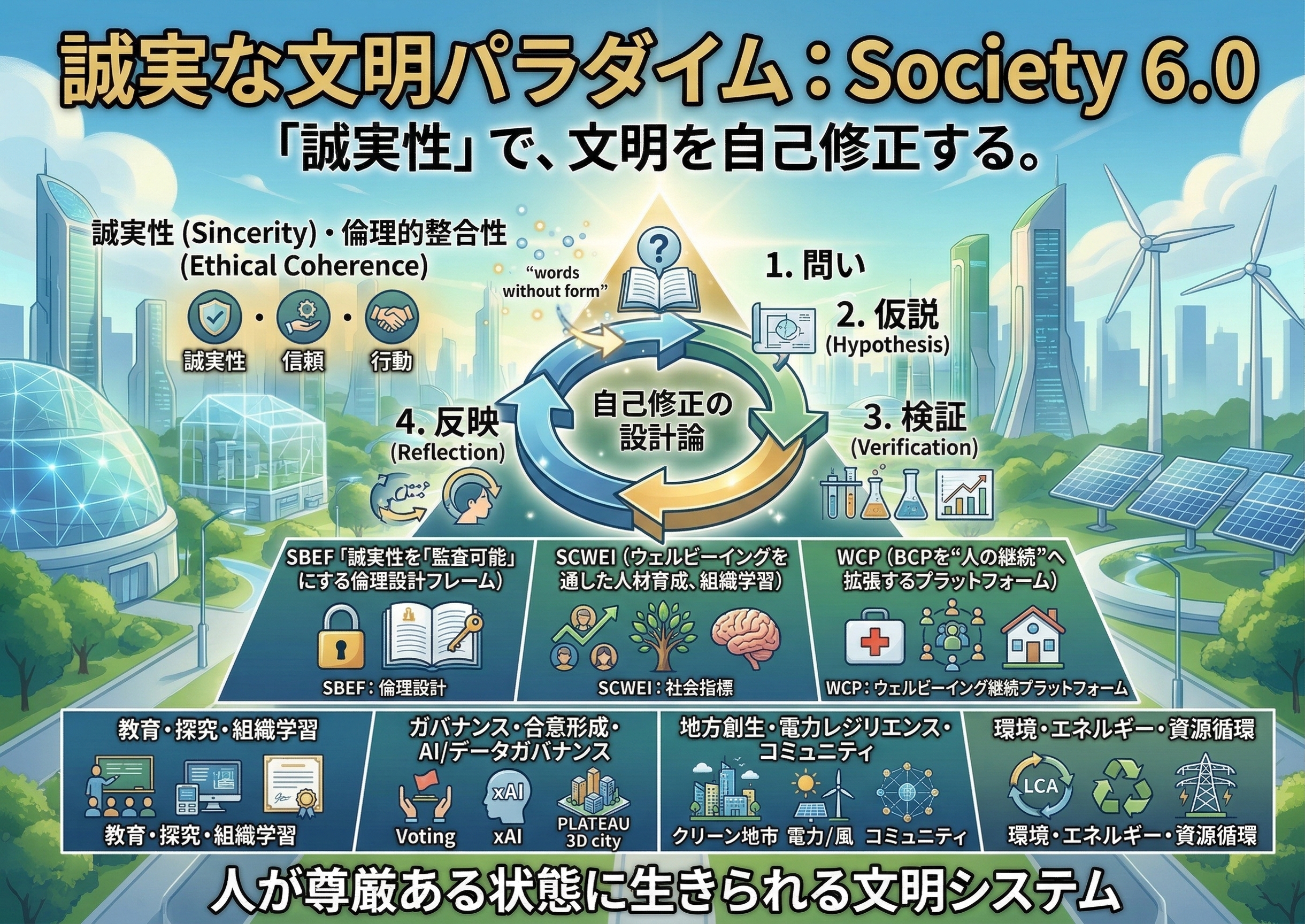
With inquiry and exploration as keywords, I am researching human resource development, organizational learning, and community building through well-being. My core interest is transforming “inarticulate discomfort” into questions, and updating society and systems to become self-correcting through a cycle of inquiry → hypothesis → verification → reflection.
I have also conceived the Well-being Continuity Platform (WCP), which expands the concept of BCP from “business continuity” to “people continuity,” and am exploring the creation of a society of integrity (Society 6.0), learning platforms, and new forms of higher education.
Self-Introduction
Toru Iwao

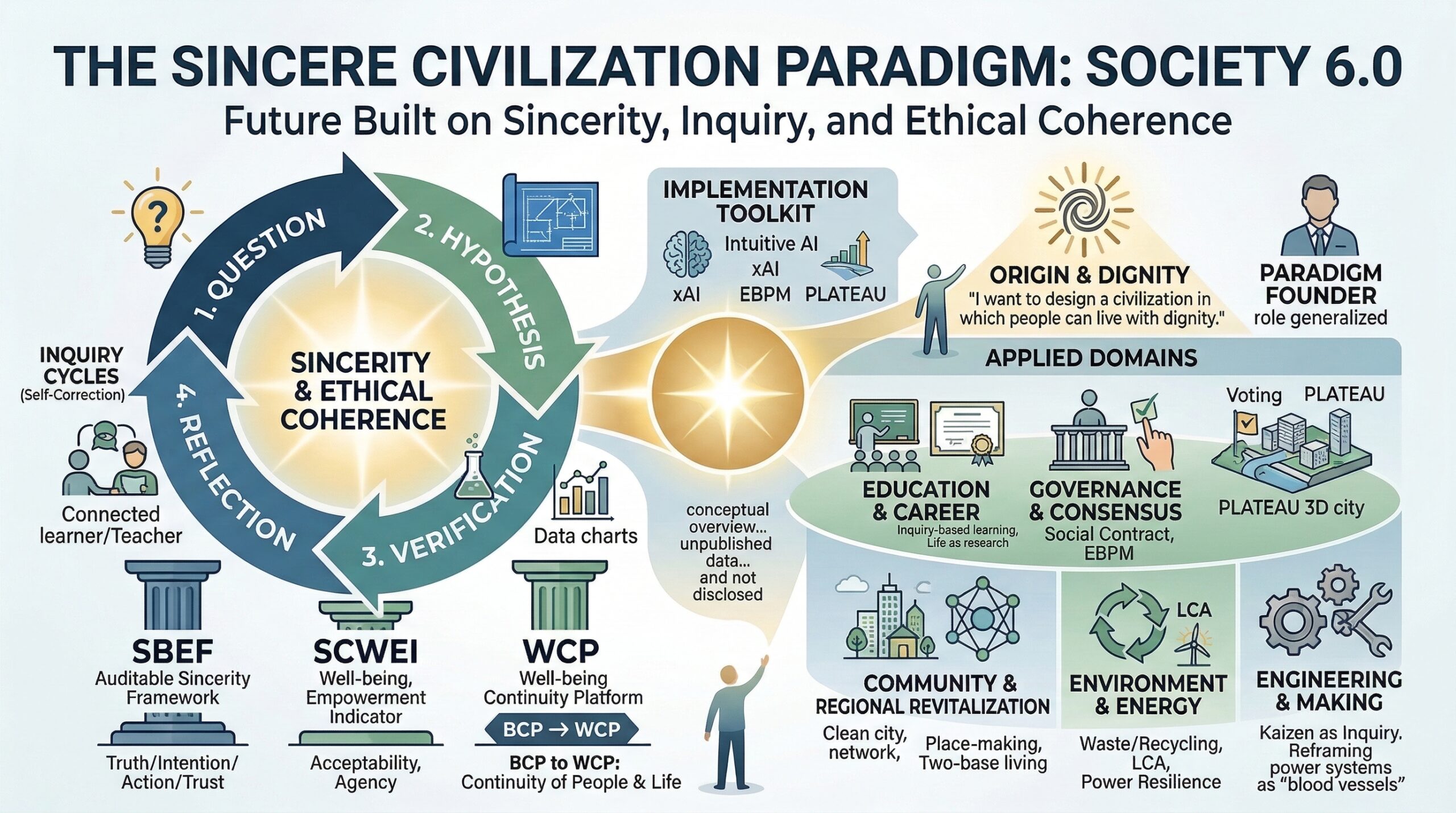
Working from sincerity (Sincerity), inquiry (Inquiry), and ethical coherence (Ethical Coherence), I connect the concept-to-implementation pathway for Society 6.0 as a self-correcting civilizational design. Using SBEF (an ethical design framework that makes sincerity auditable) as the basis for ethical operation, I translate consensus-building, social contract, governance, compliance, and AI/data governance into operable design. Concretely, I use intuitive AI + xAI, SCWEI, SBEF, EBPM, PLATEAU, and related methods to visualize value, side effects, evidence, and fairness across domains, enabling policies and on-the-ground decisions to become self-correcting. My integrated themes span education/inquiry/assessment design, career and hiring, team and talent development, regional revitalization, power resilience, BCP→WCP, circular economy (waste, recycling, LCA), and environment/energy.
- Founder of the Sincere Civilization Paradigm
- Sincere Civilization Architect
- Philosopher of Sincere Intelligence
- Systems thinker / Interdisciplinary researcher
- Working on the Sincere Civilization Paradigm and Society 6.0
He is a researcher and systems designer working on audit-ready ethical and measurement architectures for digital government strategy and socio-technical transformation. His work operationalizes sincerity, inquiry, and ethical coherence through deterministic, reproducible indicator pipelines, including the “Sincerity Core” and the Sincere Contract Well-being and Empowerment Index (SCWEI). He develops methods that combine explainable AI, evidence-based policymaking, and robust sensitivity analysis to make normative trade-offs and computational provenance inspectable. His applied interests include governance and compliance design, resilience planning, and responsible AI/data governance.
Introduction
Toru Iwao is an interdisciplinary systems thinker and researcher exploring how sincerity, inquiry, and ethical coherence can serve as design principles for a humane, transparent, and self-correcting civilization.
He proposes the Sincere Civilization Paradigm—a civilizational framework that places sincerity, rather than mere efficiency or growth, at the structural core of societal evolution. Within this paradigm, Society 6.0 functions as a working name for a dignity-centered society capable of continuous self-correction.
His research focuses on sincerity-oriented institutional design, empowerment-based governance, and measurement-enabled approaches such as WEI and SCWEI to evaluate procedural capacity, institutional resilience, and alignment with public value. He also develops and applies ethical foundations for AI and governance, including SBEF (aligning Truth / Intention / Action / Trust), alongside methods for anticipatory decision-making, transparency-by-design, and evidence-informed policy.
He further studies continuity design beyond traditional BCP, proposing WCP (Well-being Continuity Platform) as an evolution toward “continuity of people and life,” and explores inquiry-based learning ecosystems, community innovation, and governance architectures that integrate foresight and measurable accountability.
Note: This website presents public-facing conceptual overviews of the work. It does not disclose unpublished data, algorithms, or technical methods currently under peer review.
Research Keywords
- Place-based community innovation, learning platforms, future higher education
- Sincerity / integrity-by-design, ethical coherence
- Inquiry cycles: Question → Hypothesis → Verification → Reflection
- Governance architecture, social contract, consensus-building
- Composite indicators: WEI, SCWEI; measurement-enabled policy evaluation
- Anticipatory decision-making, transparency-by-design, EBPM
- AI ethics & governance (SBEF), xAI and accountability
- BCP → WCP (Well-being Continuity Platform), continuity of people and life
Origin
I want to design a civilization in which people can live with dignity—grounded in sincerity, inquiry, and ethical coherence.
Centered on sincerity, I want to help society self-correct through:
Question → Hypothesis → Verification → Reflection,
and to implement a humane and transparent civilizational system (Society 6.0) across education, organizations, communities, infrastructure, and AI.
Overview
- Society 6.0: a self-correcting society
- Sincerity: operating trust, accountability, and alignment between words and actions
- Inquiry: updating learning and institutions through Question → Hypothesis → Verification → Reflection
- Ethical Coherence: reducing contradictions among values / rules / technology / behavior
- SBEF: an ethical design framework that makes sincerity auditable (Truth / Intention / Action / Trust alignment)
- SCWEI: an indicator concept that integrates acceptability, well-being, social contract, and agency—operated to enable self-correction
- WCP: Well-being Continuity Platform (extending BCP toward “continuity of people”)
- Implementation toolkit: intuitive AI, xAI, WEI, EBPM, PLATEAU, data science, etc. to visualize value, side effects, evidence, and fairness
What I’m always thinking about
Integrated Knowledge | Society 6.0, Sincerity, Future Society
- Society 6.0 — What is a self-correcting society?
- What is sincerity? — Aligning truth, intention, action, and trust
- SBEF — A sincerity-centered ethical design framework
- SCWEI — A social indicator to operate “acceptability” with sincerity at its core
- AI and society — Who governs technology, and how?
- Mapping the future — Why “being human” is questioned more as technology advances
- Designing society with well-being × empowerment × fairness
Civilization, Electricity, and Infrastructure History | Civilization theory / the current war / standardization
- Civilization and electricity — How invisible infrastructure shaped the world
- The current war — How technology, capital, and public perception decide the outcome
- Edison vs. Tesla — Who decides the “winner” of technology?
- Standardization — A technical decision or a social contract?
- Why civilization fails, and how it can self-correct (designing self-correction)
Philosophy and Science | Civilization theory / quantum & philosophy / decision-making
- Philosophy and science — Why they split, and why they must reconnect
- Question, hypothesis, verification — Why the scientific method is strong
- Decision-making under uncertainty — How to choose without “the correct answer”
- Quantum mechanics and philosophy — What is observation? What is reality?
- Can scientific thinking support democracy?
- Can consensus be built through philosophy and science?
Science Communication | Bridging story, media, and learning
- Can science become a story? — Designing curiosity while reducing misunderstanding
- Breaking the “illusion of understanding” — Iterating intuition and verification
- Implementing scientific literacy — The interface of education and media
- Translating STEM thinking into language that truly lands
Inquiry & Education | Active learning / inquiry assessment / inquiry burnout
- Facing questions without a single correct answer
- Inquiry-based approach — Observe → Notice → Hypothesize → Test → Reflect
- Active learning: the essence and limits — designs that work vs. fail
- The structure of inquiry burnout — why it happens / how to prevent it
- Beyond impressions — building evidence, reasoning, and reflection
- Designing inquiry assessment — balancing fairness and acceptability
- Assessment reshapes learning — indicators and learning behavior
Making Inquiry Visible | Accreditation / certification / third-party evaluation
- Can inquiry capability be measured? — designing accreditation and certification
- Third-party evaluation of inquiry — balancing fairness and acceptability
- Certification transforms education — connecting learning to society
- Governance of inquiry evaluation — transparency, accountability, and trust
Parenting & Pathways | Home and school through an inquiry lens
- Parenting through inquiry — raising grades or raising question-power?
- Pathways through inquiry — what to design before choosing a school
- Dialogue at home — nurturing the habit of verification
- Learning and job search through inquiry — turning learning into capability
Dreams, Purpose, and Career | Life as “research”
- How do we find a dream? — Is it wrong not to have one?
- Connecting what you like, what you’re good at, and what society needs
- What does it mean to work? — Updating your worldview of work
- Life as research: Question → Hypothesis → Verification (career design)
Blue-Collar Millionaire / Craft-Based Career
- Blue-Collar Millionaire — building a life through technical skills
- Skill is the strongest capital and the engine of innovation — revaluing making
- Kaizen as inquiry — work becomes research
- Breaking the white/blue collar binary — what society truly needs
Job Hunting & Hiring
- The essence of job hunting — choosing an employer as a social contract
- The essence of hiring — what we see and what we miss
- What is agency? — detect / develop / evaluate
- The structure of mismatch — linking hiring and development through evaluation design
Organizations, HR, Talent Development | Team building / psychology / well-being
- A self-correcting organization — PDCA that works vs. PDCA that breaks
- When evaluation systems damage organizations — why good intentions backfire
- Psychological safety and performance — not “kindness,” but learning capacity
- Team building — design principles behind strong teams
- Talent development is environment design, not only skill training
- Designing organizations with well-being and empowerment
Governance & Compliance | Internal control / accountability / audit
- What is governance? — activating governance on the ground
- Why compliance becomes hollow
- Compliance is not morality — incentives, systems, and evaluation design
- Organizational bottlenecks — how “system holes” break organizations
- Accountability and transparency — from “said/didn’t say” to evidence-based explanation
- Making sincerity auditable with SBEF — defining and operating integrity
- Data/AI governance — who is responsible for what?
- Governance × consensus — decision-making as a social contract
Consensus and Social Contract | “How we decide” in a polarized era
- Why consensus is hard — designing decision processes
- Can the social contract be updated?
- From “more transparency” to “better dialogue” — rebuttal, revision, reflection
- Embedding self-correction into institutions — legitimacy recovery and recurrence prevention
Community / Place-making / “Thing-making”
- Can dialogue change society?
- Can communities be designed? — building relationships and mechanisms
- Philosophical dialogue in the city
- Learning “how to sustain a place”
- How to make things happen — build small, grow, and scale
City Design & Regional Revitalization | Two-base living / relocation / “a place you want to return to”
- Why regional revitalization is hard — conditions for success and failure
- Two-base living as a strategy — connecting cities and regions
- Can relocation succeed? — designing life, work, and relationships
- Designing an attractive city people want to return to
- Creating regional circulation through community and infrastructure
Environment & Energy Policy | Intuitive AI / xAI / SCWEI / SBEF / EBPM / PLATEAU
- Evaluating policy with intuitive AI + xAI — one-view of value, side effects, and evidence
- Operating acceptability with WEI — households, industries, and regions on one map
- Always-on EBPM — Observe → Notice → Verify → Reflect
- PLATEAU linkage — visualizing regional differences and causes to strengthen consensus and accountability
- Deciding the energy mix — acceptance, reliability, stability, and fairness
- Electricity markets and tariffs — for whom is the system designed?
- Reliability and grid stability — prioritizing resilience investments
- Public transit × energy — linking demand management, urban policy, and corridor value
- Statistics and ABM — understanding markets and demand/supply; counterfactual comparisons for evidence
Power Resilience & Disaster Response
- Power resilience and disaster response — designing protection against outages
- Critical facilities, regional bias, restoration priority — deciding with fairness
- Prioritizing resilience investment — agreeing on what we protect
BCP → WCP | Continuity design (WCP = Well-being Continuity Platform)
- BCP is not “disaster prevention” — designing continuity
- WCP — implementing continuity of people (keeping life/organizations/communities going)
- BCP × WCP — optimizing critical operations and life continuity together
- Crisis decision-making — scenario comparison and operating self-correction
- Exercise-based: redesigning how your organization/region “stops” (table-top simulation)
Waste Management / Recycling / Circular Economy | Environment / ecosystem / LCA
- Waste management as a social contract — who bears costs and who benefits?
- Why recycling doesn’t “turn” — a design problem beyond sorting
- Circularity doesn’t run on goodwill — incentives, pricing, and institutions
- Resilience of reverse logistics infrastructure — disaster waste and recovery design
- What is “environment”? — ecosystems as relationships
- Urban metabolism — seeing cities through material circulation
- LCA basics — verifying whether “good” is truly good
- Beyond carbon — evaluating side effects with LCA
- Lifecycle optimization — connecting design, procurement, production, logistics, and recovery
Railways and Public Transit | City value, publicness, energy linkage
- How railways change cities — corridor value and publicness
- Public transit and regional revitalization — mobility reshapes life
- Public transit × energy — linking urban policy and infrastructure
Engineering & Making | Electricity / mechanics / metalworking / power / quality
- Making supports civilization — field inquiry changes society
- Electricity, mechanics, metalworking — the essence of technology is reproducibility
- What is quality? — it is ethics and trust
- Scientific kaizen — data + hypotheses for improvement
- Reframing power systems as the “blood vessels” of civilization
Data Science | Evaluation / policy / organizations / society
- Can data science make people happier?
- Indicators are worldviews — what you measure decides the future
- Modeling society — statistics, ABM, scenario comparison
- Can AI question its own assumptions?
- Operating AI ethics — connecting SBEF to governance
Space | A space lens on civilization, energy, resilience
- Viewing civilization from space — infrastructure, energy, survival strategy
- Social design in the space era — what counts as “public”?
- What extreme environments teach resilience — redefining disaster readiness on Earth
This framework can also expand into combinations such as: civilization history × governance / inquiry × career / power resilience × city design / BCP→WCP × circular economy × consensus, etc.
Roles / 役割
1. Philosopher of Sincere Intelligence(誠実知の哲学者)
- 誠実性(Integrity)と問い(Inquiry)を結びつけ
- 人間が「どう誠実に考え、どう誠実に応答するか」を探究
- 哲学・認知科学・教育・倫理を横断した「思索の領域」
2. Sincere Civilization Architect(誠実文明アーキテクト)
- 社会OS、都市、制度、公共AI、レジリエンスの設計
- 誠実性に基づく社会アーキテクチャの再構築
- Society 6.0、FELIXモデル等の文明設計思想の開発(※概念レベルのみ記載)
3. Founder of the Sincere Civilization Paradigm(誠実文明パラダイム創始者)
- 誠実 × 問い × 共鳴 × 社会OS に基づく新しい文明理論
- 人類の次の社会モデルの「構造」を提示
- 工学・倫理・思想・社会科学を統合した独自のフレーム
Research Themes / 研究テーマ
1. Sincere Civilization Paradigm
誠実性・制度的整合性・問いの文化を、文明の基盤とする新しい概念モデル。
2. Sincere Intelligence(誠実知)
自分と他者と社会に誠実であろうとする知性。探究・倫理・意味理解を統合する新しい知性概念。
3. Social Systems Architecture
交通、エネルギー、教育、福祉、医療など、社会システム全体の構造を、誠実性・信頼・透明性で再設計する理論研究。
4. Institutional Integrity & Ethical Governance
説明責任、応答責任、透明性、信頼構造など、公共・行政・組織の倫理と制度設計。
5. Inquiry-Based Learning & Civic Capability
問い(Qchain)を中心にした探究文化、市民が学び続ける社会の構造。
※ 新規性・査読保護のため、具体的手法やアルゴリズムは一切記載していません。
Mission / 使命
To articulate how sincerity, inquiry, and ethical coherence can serve as guiding principles for designing humane, transparent, and future-ready civilizational systems.
誠実性・問い・倫理的整合性を軸に、「人が尊厳ある状態に生きられる文明」を設計する。
免責事項(COI・新規性保護)
- 本サイトは 個人の研究・思想サイト であり、所属機関・団体の公式見解ではありません。
- 審査中の論文・未公表手法・アルゴリズム・データには一切触れていません。
- 本文はすべて 新規のオリジナル文章 であり、他媒体のコピーは含みません。
- 投資・勧誘・営業等の意図を含まず、研究目的の情報サイトです。